
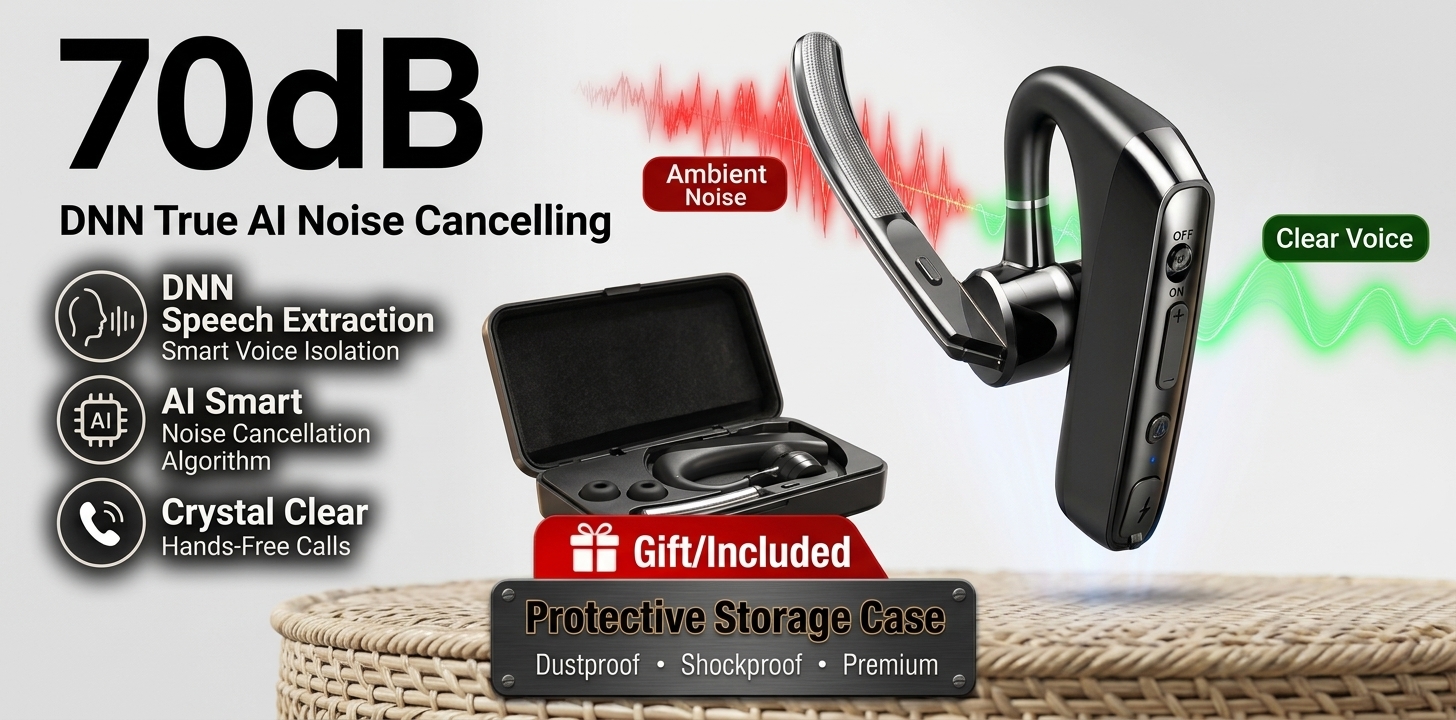
Recently, a valued distributor in Indonesia brought an intriguing real-world testing case to our attention regarding the DBS V8H AI Noise-Canceling Headset:
The partner reported that while the V8H provides exceptional noise cancellation during standard phone calls and live voice/video calls (on WeChat & WhatsApp), background noise often leaks specifically when sending short voice messages (voice notes) on a Google Pixel 7a.
Interestingly, further testing revealed that this phenomenon on the Pixel 7a was not unique to the V8H—almost all third-party noise-canceling headsets experienced reduced noise suppression during voice notes on this specific phone, with only rare exceptions (such as OpenRock) maintaining suppression.
Meanwhile, our internal QA testing confirmed that across mainstream iOS and Android ecosystems—including iPhone, Huawei, Xiaomi, vivo, and OPPO—the V8H delivers consistent, high-performance AI noise cancellation across cellular calls, VoIP voice calls, AND app voice messages.
As an audio engineering team committed to technical transparency, we conducted a systematic protocol analysis to explain why this device-specific behavior occurs.
1. Technical Analysis: Why Does It Happen Only on Specific Google Models?
To understand why a headset's noise cancellation behaves differently between a "Live Call" and a "Voice Message" on certain devices, we must examine how mobile operating systems handle audio streams at the HAL (Hardware Abstraction Layer) level.
A. Communication Profile (HFP/SCO) vs. Recording Profile (A2DP/BLE/SCO)
Standard Calls & Live VoIP Calls (Full-Duplex): When you initiate a phone call or a live WeChat/WhatsApp voice call, the smartphone OS strictly invokes the HFP (Hands-Free Profile). This forces the audio pipeline to run directly through the headset’s internal DSP hardware and DNN AI processor, ensuring 100% active noise suppression before the audio reaches the phone.
Voice Note Recording (Half-Duplex Short Audio): When you press "Hold to Talk" in messaging apps, the OS does not treat this as a "call". Instead, it requests a brief audio recording stream.
B. Google Pixel 7a & Native Android Audio Routing Policies
On iOS and heavily customized Android ROMs (such as MIUI, OriginOS, EMUI, or ColorOS), the operating system automatically forces the Bluetooth connection into communication-grade DSP processing whenever an app requests microphone input.
However, on native or near-native Android builds (like Google Pixel 7a):
Audio Profile Handshake Delay/Bypass: When recording a short voice note, the native Android OS audio manager often requests a generic media-recording profile rather than triggering a full HFP/SCO communication handshake.
DSP Activation Conflict: Because the phone OS does not signal a "call state" to the Bluetooth accessory, standard headset firmware may not trigger its maximum DNN (Deep Neural Network) active noise suppression algorithms, resulting in ambient background noise being encoded into the voice note file.
This explains why almost all standard Bluetooth noise-canceling headsets experience this issue on Pixel 7a—it is fundamentally driven by the smartphone OS audio routing framework rather than a headset hardware flaw.
2. Action Plan: How Kovwireless Is Addressing This
Understanding that device-specific OS behaviors exist in the global market, Kovwireless is taking proactive engineering steps rather than leaving the resolution to smartphone OEMs:
Step 1: Firmware-Level Protocol Adaptation
Our R&D team is analyzing the SCO/HFP profile switching parameters used by headsets that maintain suppression (such as OpenRock) on native Android builds. We are optimizing the V8H Bluetooth Firmware Stack to implement a "Fast HFP Handshake" protocol. This update will force the headset’s independent DNN AI chip into high-priority noise-suppression mode immediately upon detecting any microphone recording request, regardless of whether the OS flags it as a call or a voice note.
Step 2: Global Compatibility Matrix & Firmware Distribution
Once testing and verification are finalized, Kovwireless will release an OTA/U-disk firmware patch for B2B partners and distributors. This will ensure seamless, universal noise cancellation performance across all smartphone brands, including native Google Pixel devices.
Conclusion: Engineering Support You Can Rely On
In the complex ecosystem of global wireless audio, smartphone OS audio HAL policies continuously evolve. At Kovwireless, we don't ignore edge cases—we analyze them, engineer solutions, and continuously upgrade our product ecosystem to support our global partners.
If you have specific device compatibility questions or require technical support for your region, please reach out directly to our engineering team at kovwireless.com.